
SEO PPC CPC? The Ultimate Digital Marketing Jargon Buster
March 30, 2017
Social Media Summit Ireland
April 13, 2017

Do you use social media for business?
Are you wondering which social networks will deliver the greatest Return on Investment (ROI) for your business?
After reading this article, you will have a clear idea of how to choose the right social networks for your business.
Should my business be on social media at all?
Yes. Unless your audience are not active on any form of social media and never will be (which is pretty much no one).
Marketing is all about attention. Wherever your audience’s attention is, your business should be building a community, providing value and forming meaningful relationships.
If you don’t think your audience is on social media because they are ‘too old’ think again. 64% of 50-64 year olds in the US now use at least one social media site. 34% of 65+ year olds use at least one social media site.
There were also 2.789 billion active social media users as of January 2017 (that’s 37% of world’s population!)

Are people actually paying attention to social media though? Yes. People are spending an average of 1 hour 48 minutes using social media each day in the UK alone.

How many social networks should I be using?
In short, it’s much better to use a small amount of social networks (2-5) well than to spread yourself thin and use them badly. However…don’t put your fate in the hands of one platform. If that platform closes down tomorrow, where else will your ideal customer find and engage with you?
The longer answer…
The amount of additional social networks you should use after choosing the best 2 social networks for your business depends on 2 key things;
1️. How does using the additional social network well benefit your business? Could those resources/ budget be pumped into other marketing channels/ current social networks to produce better results?
2. Do you have the resources/ budget to use the additional social network to a high standard without dramatically reducing the quality and ROI of what you are doing on the social network(s) you are currently using?
If using the additional social network well is the best use of your resources and doesn’t have a significant negative impact on your current ROI, then you should go for it.
How do I choose the right social network for my business?
First off, unless you’re in some crazy niche, or targeting a specific country like China or Russia, I’d stick to choosing from the ‘big players’ initially (Facebook, Instagram, Snapchat, YouTube, Twitter, LinkedIn, Pinterest).
The right social network for your business will be the one which is graded the highest against the following 3 questions;
? Which social network(s) are your ideal customers paying most attention to now and in the future?
? Which social network(s) make sense for the skills you/ your team have?
? Which social network(s) will you/ your team enjoy using?
Let’s break these questions down into 3 more detailed steps to help your decision making process.
Step #1 Decide which social network(s) your ideal customers are paying most attention to
Before doing this exercise, you need to identify who your ideal customers are. Virgin Startups video can also help you with this.
Once you’ve identified them, analyse the following social network demographics and usage stats to see which ones your ideal customers are paying most attention to.
Active Monthly Users
Let’s firstly look at each social network’s active monthly users;
Facebook (Social Media Powerhouse): 1.871 billion
Facebook is the powerhouse of social networks. Statistically, your ideal customers are likely to be on the platform in some form due to its huge user base. It also has the most powerful Ads platform known to man, making it quick, easy and cheap to reach your ideal customers.
YouTube (Video Search Engine Queen): 1 billion
The second largest search engine on the planet (after Google) with 3 billion searches a month. YouTube is all about video. If you want your videos to get discovered, you need to be on YouTube. Lloyd wrote an article on how to grow your YouTube Channel which you should also check out.
Instagram (Photo & Video Rising Star): 600 million
Instagram has doubled in size over the last 2 years. It started as THE go to social network for high quality photography. It has since evolved into a photo, video, storytelling beast which is showing no signs of slowing down. If your business is visual, you need to be on Instagram.
Twitter (Conversation and Customer Service King): 317 million
Twitter’s 140 character limit ‘Tweets’ make it an ideal social network for short, sharp conversations. If you want to get an instant response from a company, you Tweet them. Twitter is a great place to network and build relationships with your ideal and current customers. Twitter has seen a steady growth decline in the last year, however it’s still an incredibly powerful platform which shouldn’t be ignored.
Snapchat (The Orginal Storyteller): 300 million
If you’re targeting millennials, Snapchat is where you need to be. It’s disappearing videos and impressive face-tracking lenses make it a cool spot to hangout. Since Snapchat came out, Facebook, Instagram, Whatsapp & more have copied it’s disappearing storytelling video features. If you have a creative team, they’ll love Snapchat.
Pinterest (Arts, Crafts & Designers Dream): 150 million
Pinterest is a social network that allows users to visually share, and discover new interests by posting (known as ‘pinning’ on Pinterest) images or videos to their own or others’ boards (i.e. a collection of ‘pins,’ usually with a common theme). This is where people (mainly women) go for creative ideas around design, arts,crafts and more.
LinkedIn (The Business Powerhouse): 106 million
LinkedIn is where serious business people hang out. People don’t go there to look at happy go lucky videos of people in your office being silly. Linkedin is your digital business card. If you are in business at all, you should have a personal profile at a minimum.

In my personal opinion, I believe that most businesses should be on Facebook and here’s why;
Facebook is an absolute powerhouse and it’s only going to get bigger. It’s here to stick around. 25% of the world’s population are on Facebook making it likely that a percentage of your ideal customer’s attention will be there.
It’s also got THE most powerful Ads platform (even better than Google) which makes it incredibly easy and currently very cheap to reach your ideal customer.
Social Networks Demographics
Pew Research Internet Project has been gathering social media demographic statistics for the last several years.
Their latest results give some interesting insights into the % of US adults who use each social media platform.
Facebook obviously trumps all due to it’s large user base, however, it’s useful to look at the social networks which come second in terms of the percentage of users in each demographic (coloured with red text).
Cross reference the data below with the ‘ideal customer’ profile you have developed.
| Total | 68% | 28% | 26% | 25% | 21% |
| Men | 67% | 23% | 15% | 28% | 21% |
| Women | 69% | 32% | 38% | 23% | 21% |
| Ages 18-29 | 88% | 59% | 36% | 34% | 36% |
| 30-49 | 79% | 31% | 32% | 31% | 22% |
| 50-64 | 61% | 13% | 24% | 21% | 18% |
| 65+ | 36% | 5% | 9% | 11% | 6% |
| High school or less | 56% | 19% | 18% | 9% | 14% |
| Some college | 77% | 35% | 31% | 25% | 24% |
| College graduate | 77% | 32% | 33% | 49% | 28% |
| Less than $30,000 | 65% | 29% | 23% | 16% | 18% |
| $30,000-$49,999 | 68% | 27% | 27% | 11% | 16% |
| $50,000-$74,999 | 70% | 30% | 29% | 30% | 26% |
| $75,000+ | 76% | 30% | 34% | 45% | 30% |
| Urban | 70% | 34% | 26% | 29% | 22% |
| Suburban | 68% | 24% | 29% | 26% | 21% |
| Rural | 65% | 25% | 20% | 15% | 19% |
Pew Research Internet Project didn’t include data for Snapchat and YouTube, you can find this data below.
Snapchat
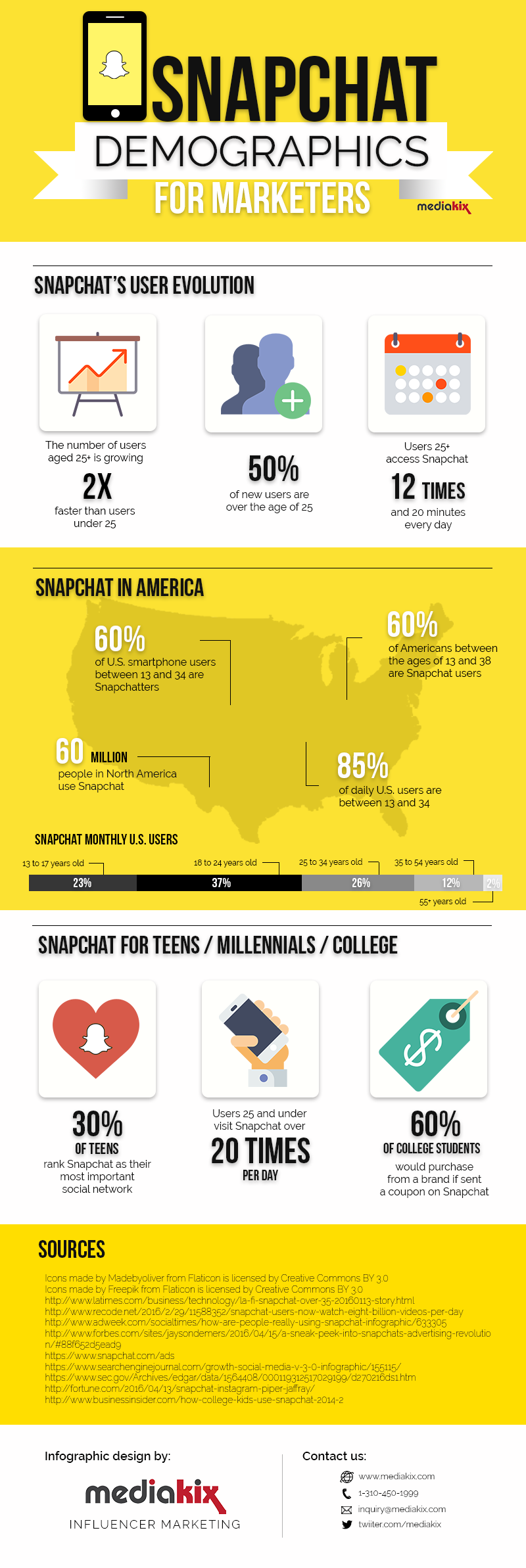
Snapchat users are young, female, and well distributed throughout Europe, North America, Asia, and the Middle East. While Snapchat use among adults up to age 55 is growing fast, Baby Boomers are still a tiny fraction of the Snapchat user base.
As we’ve seen with previous platforms like Facebook and Instagram, the demographic is aging up (the wrinkleys want to get involved when they see their kids having fun). Over 50% of new Snapchat users are over the age of 25 and the percentage growth of those aged 35 years and older is actually greater than the penetration rate for 18- to 24-year-olds.
YouTube
YouTube’s gender demographic breakdown is a 50/50 split. According to comScore, YouTube reaches 95% of online adults 35+ & 55+ in a month. Check out more YouTube stats and demographics below.

Sprout Social have also produced a Social Media Demographics Report which you should look at.
Tracx have produced a 2017 State of Social Infographic which is another handy resource.
Step #2 Decide which social networks make sense for the skills you/ your team have
You may think this sounds ‘fluffy’ but it’s honestly not.
If you have an incredible photographer on your team, they’re likely to kill it on Instagram and are probably doing so already with their own personal account.
If you have someone who is great at networking, they’ll shine on the Twitter scene.
Take a look at the definitions under each social network above and see how your team’s skills could fit in with each. If you want more detail on the skills needed for each social network, then enter the following search term into Google;
Skills needed for [enter social network] marketing
Step #3 Decide which social networks you/ your team enjoy using
You may think this sounds even more fluffy, but again, it’s not. There’s method behind the madness.
It’s a well-known fact that when you enjoy something, you perform better at it.
You’re destined for failure if you’re constantly pushing you/ your team to use a network that you/ they don’t like or get along with.
So how do you decide if you ‘get’ and enjoy using a network? You use it.
You/ your team need to sign up and test each platform. Does it feel right? Do you ‘get it’? More importantly, did you enjoy using it?
Final Thoughts
The best way to choose the right social networks for your business is to test them out and measure the ROI of your efforts.
However…
I completely get that this isn’t always possible due to your limited time and resources…which is why I created this post to guide your decision making process.
Over to you!
This is it. It’s time. You’ve read/ skimmed this post, now it’s time to actually do something!
Which social networks will you be choosing and why? Let me know in the comments below.

Daniel Knowlton
Dan is the award winning Co-founder of KPS Digital Marketing who was named #12 Most Influential Digital Marketer on Twitter in the world in 2016 by Onalytica. Dan is a contributor for a variety of key marketing publications including Social Media Examiner, Content Marketing Institute and Jeff Bullas’ Blog. He is also a keen speaker and has spoken at events internationally for a variety of organisations including NatWest and The Royal institute of Chartered Surveyors. Dan has a passion for helping others learn how to get to grips with Digital Marketing and is obsessed with providing value for his community.